


As of 1 October 2026, the procedure for declaring fumigated bulk cargo via the Vessel Notification service in Portbase’s Port Community System (PCS) will change. Notification details will henceforth be entered in a single, central location within the web screens or via the API. This eliminates the need to submit this information both via Portbase and separately by email (or other means), thereby simplifying the notification process. Additionally, you can easily specify the fumigation method used.
The API updates (version 6) will be available starting October 1st. Initially, they are optional, but they will become mandatory as of January 11, 2027. You can find the details regarding the changes in this release note.
What changes in the web screens and the API as of October 1, 2026
If cargo has been disinfected or fumigated abroad, you must report this information to the harbour master prior to arrival at the port. Furthermore, the handling of the vessel must be carried out in accordance with the action plan established by the harbour master (Amsterdam and Rotterdam, both documents are in Dutch) for fumigated cargo: ‘Action plan for seagoing vessels with cargo fumigated abroad with phosphine’.
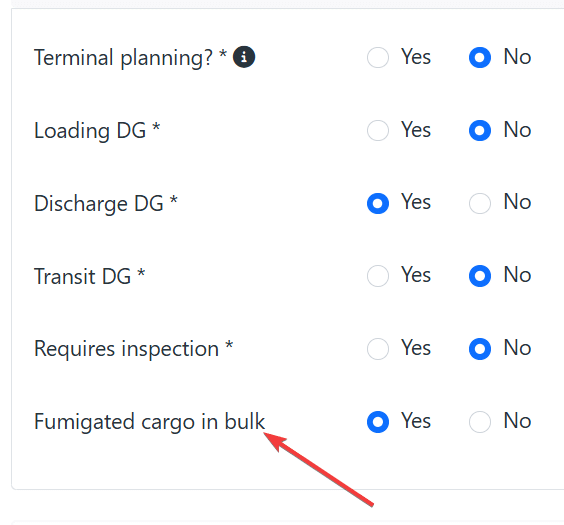
To make the reporting process clearer, you will now submit the data from the Plan of Action directly via the web screens in Vessel Notification or via the API. You do this within the visit (as shown in the image below).
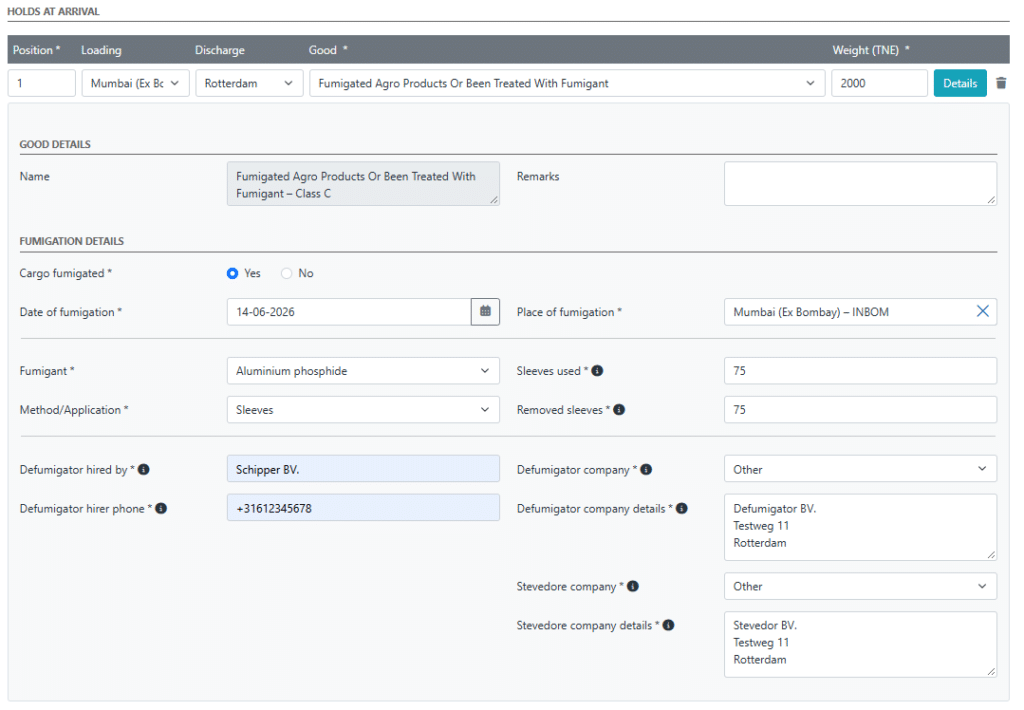
And in the dangerous goods declaration screen, when you select the fumigation method from the dropdown menu. If you choose phosphine, aluminium phosphide, or magnesium phosphide, you must indicate whether sleeves or loose tablets were used. Additionally, you must specify:
- the number of sleeves added at the loading port;
- the number of sleeves with residues that were removed;
- the name and contact details of the party that commissioned the fumigation supervisor;
- the name and contact details of the fumigation supervisor accompanying the vessel;
- the name and contact details of the company handling the vessel’s discharge and aeration;
No new obligations are being introduced; you will simply report this existing information in one central location within Portbase’s PCS from now on. A screenshot showing what this looks like is provided below.
This information is necessary to safely unload and transport the fumigated cargo. In practice, loose tablets do not always fully react; if residues end up in an inland vessel during unloading, they can react again and release toxic phosphine gas at a later stage. This can create a life-threatening situation. Knowing the fumigation method used in advance allows the parties involved to take appropriate safety measures.
Availability by channel
| Channel | Availability and operation |
| Declare Visit API | Only the new field fumigatedCargoInBulk can be submitted when creating a visit. This field is not yet mandatory from 1 October 2026 up to and including 10 January 2027. From 11 January 2027, the field is mandatory. |
| Tracking API | All new fields are available for retrieval. The Tracking API is read-only for this data. |
| Web scheens Vessel Notification | All new fields will be available from 1 October 2026. The specific situation determines which fields are applicable and mandatory. Where a field is mandatory, this requirement applies from 1 October 2026. |
New fumigation fields in the web screens and field names in the API
The fields listed below will be available in the service Vessel Notification starting 1 October 2026, along with the corresponding fields in the API.
| Field in Vessel Notification | Field in the API | Meaning |
| Fumigated cargo in bulk | fumigatedCargoInBulk | Whether the bulk cargo has been fumigated |
| Location of fumigation | locationOfFumigation | Port where the fumigation took place. |
| Fumigant application | fumigantApplication | Method by which the fumigant is applied. |
| Sleeves used | sleevesUsed | Number of sleeves used. |
| Sleeves removed | sleevesRemoved | Number of removed sleeves. |
| Defumigator hired by | defumigatorHiredBy | Party that hired the defumigator company. |
| Defumigator hirer phone | defumigatorHirerPhone | Telephone number of the party that hired the defumigator company. |
| Defumigator company | defumigatorCompany | Company carrying out the defumigation. |
| Defumigator company details | defumigatorCompanyDetails | Name and contact details of the defumigator company. |
| Fumigation stevedore | fumigationStevedore | Company carrying out unloading and mucking operations. |
| Stevedore company details | stevedoreCompanyDetails | Stevedore company details. |


