
Case
Keeping Customs moving
“With its Port Community System, Portbase is in many cases the gateway for businesses to conduct operations in the port. Ultimately, Customs also benefits from this centralized approach.” — Peter van Buijtenen, Regional Director, Customs Rotterdam Port
‘In the Netherlands, we do things together’
Customs prefers to disrupt the logistics process as little as possible. According to Jan Kamp and Peter van Buijtenen of the Customs Rotterdam Port region, this is only possible when collaboration is strong, for example by sharing data with one another at an early stage. In that respect, they assign an important role to Portbase, as the data hub of the Port of Rotterdam.
Jan Kamp (left) served as Regional Director of Customs Rotterdam Port for the past four years. He was recently succeeded by Peter van Buijtenen (right). Both have held multiple positions within Customs over the past decades and therefore know all aspects of the customs profession.
The Brexit, increasing drug-related crime in the port, and the war in Ukraine: Customs in the Port of Rotterdam is regularly confronted with complex challenges. How are these dealt with?
Peter van Buijtenen (PB): ‘Often such challenges have multiple dimensions. Take Brexit, for example. For that, we had to establish an entirely new work process. We also had to recruit nearly a thousand people in a short period of time for the additional work. We are now a few years further on, and it is gradually becoming business as usual. But we are still not finished.’
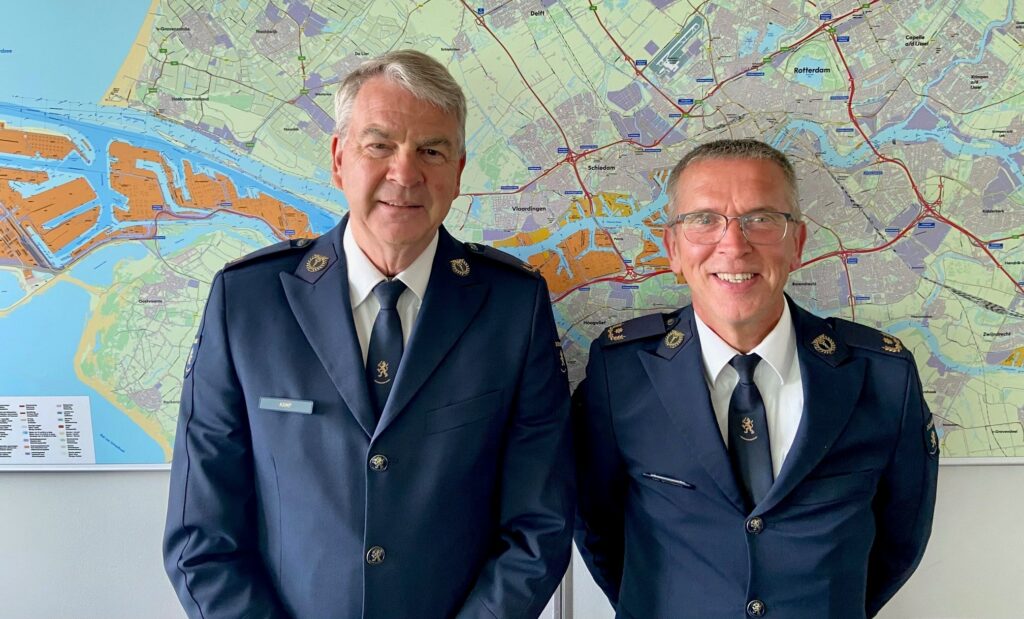
Jan Kamp (left) and Peter van Buijtenen (right)
Former and current Regional Director of Customs Rotterdam Port
Copyright photo’s: Customs Netherlands, Portbase
‘It is quite unique how we interact with one another in the port’
Jan Kamp (JK): ‘When the war in Ukraine began, we suddenly found ourselves in a difficult situation. Not all sanctions measures were immediately clear, but of course you want to get it right from the start. Out of intrinsic motivation, you do everything you can at such a moment to gain clarity and to avoid unnecessarily disrupting the logistics process.’
What is the key to success in dealing with challenges like these?
JK: ‘What I am quite proud of is that we have been able to handle such complex tasks time and again. It undoubtedly required blood, sweat and tears, but during Brexit the port never came to a standstill. We also managed to integrate Brexit into the existing organisation. That was far from simple, because it demanded a great deal from everyone involved. I believe that is the key to success: putting our shoulders to the wheel together. Exactly as happened with Brexit. Internally, where the existing staff supported and trained the new colleagues as well as possible. But also externally, with the combined strength of all parties involved in the port.’
PB: ‘I see it the same way. And even today I still see plenty of such examples. Take the approach to tackling undermining crime, for instance. We deliberately take a port‑wide approach. Together with the Seaport Police, with Deltalinqs as the representative of port businesses, with the municipality and of course also with Portbase, to name just a few.’
Has the experience gained so far begun to pay off?
JK: ‘Absolutely. While collaboration in the past sometimes started a little hesitantly, you now see that we find each other naturally. It has become a kind of automatic behaviour, because by now we all know the value of working together.’
When it comes to collaboration and what it delivers, you sometimes see other ports looking at the Netherlands with a touch of envy. Do you experience that as well?
PB: ‘It is quite unique how we interact with one another in the port. You do not see that very often. More often there is a top‑down structure, where the enforcement organisation decides and businesses have to follow. In the Netherlands, we do it together and coordinate as much as possible. This is also how the regular Customs Business Consultation was established, for example.’
Collaboration between Customs and Portbase
The collaboration between Customs and Portbase has already been briefly mentioned. How would you describe that collaboration?
PB: ‘Portbase is of course a special kind of organisation for us. It cannot be compared with, for example, a terminal. Portbase is not a customer of Customs, but rather a supplier. Yet calling Portbase simply a supplier does not do it justice. With its Port Community System, Portbase is in many cases the gateway for businesses to conduct operations in the port. Customs ultimately also benefits from this centralised approach.’
JK: ‘At Schiphol, we once wanted to set up a similar system, but it never took off. At least, not in the way we have managed to organise it with Portbase. The Port Community System is not seen by the port community as a form of forced procurement, but as added value. On a voluntary basis, not because they are obliged to, port parties provide their data to Portbase. Not necessarily out of self‑interest, but with the collective interest of the port in mind. That is remarkable and a compliment to Portbase, which has managed to achieve this.’Portbase is of course a special kind of organisation for us. It cannot be compared with, for example, a terminal. Portbase is not a customer of Customs, but rather a supplier.
JK: ‘The added value of Portbase was also evident during Brexit. With its already existing Port Community System, Portbase, as a neutral, non‑commercial and therefore reliable organisation in the Port of Rotterdam, was able to realise an appropriate chain solution in coordination with the port community. As far as I am concerned, a textbook example of what Portbase can mean for the port and therefore also for us.’
What developments do you think Customs will face in the context of Portbase and its Port Community System?
PB: ‘Ambitions in the field of data management remain high. For us and for others. For instance, the European Union wants to establish a central data hub, although political decision‑making on this is still to follow. They want this data hub for security reasons, to gain clearer insight into which goods are entering the European Union. At the moment, Portbase is working on a plan of approach specifically for the Dutch situation. This is being developed in coordination with, among others, the Association of Rotterdam Shipbrokers and also with us. Because once again, you only achieve the best possible solution together.’
JK: ‘But there is much more going on. For example, we want to create a port‑wide administration for the temporary storage of containers in the Port of Rotterdam. That will enable better supervision, with even fewer disruptions to the logistics process. Together with Portbase and other port parties, we are working hard to achieve this.’
Is there anything left to wish for?
JK: ‘Of course, because it can always be improved. One of our priorities is to have access to crucial logistics data even earlier. This would allow us to intervene in the logistics process more precisely and only at moments when it is truly necessary. Ultimately, having access to real‑time logistics data would be ideal. That will generate benefits for all parties in the Port of Rotterdam, because it will allow us to reduce the number of inspections even further. In this context, we see Portbase as a crucial organisation. But Portbase does not bear that responsibility alone. This is another complex challenge where you must work together to achieve the best solution. So it always begins and ends with collaboration, that much should now be clear.’
New Customs CIO Frank Dijkstra
Frank Dijkstra is the new CIO at Customs Netherlands. He strongly agrees with the views of Kamp and Van Buijtenen. Dijkstra sees many opportunities, for example, in the field of data‑driven working within Customs. ‘We want to be a data‑driven organisation. For example, by basing enforcement decisions increasingly on data analyses and algorithms that can predict risks. Ultimately, we want to create a fully fledged data platform for this purpose. To collect and analyse data securely. But also to make data available, for instance in the algorithms mentioned earlier.’
‘More and more logistics parties want access to customs‑related data, preferably tailored, in order to work even more efficiently. Customs understands this and therefore increasingly chooses to exchange data and risk signals across different work areas with the logistics sector. For example in relation to the scanning of goods and the processing of declaration data.’
‘Further developing our algorithms is both desirable and necessary. On the one hand to cope with the sharply rising volumes of declarations. On the other hand to combat criminal infiltration. In addition, we expect to be able to significantly improve our hit rate through the use of advanced algorithms.’
‘Data‑driven working also requires more than just technology. You also need specific knowledge and skills to apply that technology effectively. Having a great data platform alone is not enough. You must also be able to make optimal use of it, otherwise it will not take off and we will not become a truly data‑driven organisation. That is still a challenge for us.’