
Cargo Controller Import information in your own systems
Getting started with the Cargo Controller Import API
The Cargo Controller Import API is useful for any organisation that tracks more than 20 Bills of Lading (B/Ls) per week and wishes to automate its import processes. Among other things, the API allows you to prepare customs declarations and automatically process status updates for cargo arriving via Dutch ports.
Here you can read about the experiences of other users and learn how to prepare your organisation before requesting the API.


Benefits of an API integration
- Processing of all cargo status updates directly within your own system.
- Full automation regarding Customs blocks and missing statuses, enabling faster action and the prevention of delays.
- Visibility for critical moments in the logistics process, tailored to your own workflows and alerts.
How do I prepare for an API implementation?
Thorough preparation speeds up the implementation timeline. Based on experience with other companies, a standard implementation takes approximately 12 weeks. Assemble a project team comprising the following roles:
Developers
One or more developers with knowledge of RESTful APIs, security, and JSON Web Tokens.
Consultant
A consultant from your software vendor, if the API is not developed in-house.
Forwarder
(Optional) an experienced forwarder with knowledge of the import process and the associated alerts
Customs declarant
(Optional) a customs declarant familiar with the benefits of Import Documentation Notification. Read more here.
Implementation choices
When setting up a system integration with Portbase, you have two implementation options to choose from. Make this decision in consultation with your implementation team beforehand. There are pros and cons for both options. The choice is a matter of preference and also depends on whether or not you are working with a software vendor known to Portbase.
1 . Testing in the production environment
Use the production environment for the implementation. Suitable when you want to activate the integration quickly and in a controlled manner.
2 . Testing in a test environment
Test the integration in a separate environment first before deploying it to production. This is ideal for validating processes and settings in advance.
An article containing the API specifications is available for developers. It also outlines the steps for connecting to our test and/or production environments.
Choose a software suplier
Check whether your software provider is already known to Portbase. If you work with a partner that has already connected, the lead time is often significantly shorter. On averaging 4–8 weeks.


More insight via Premium Terminal Data add-ons
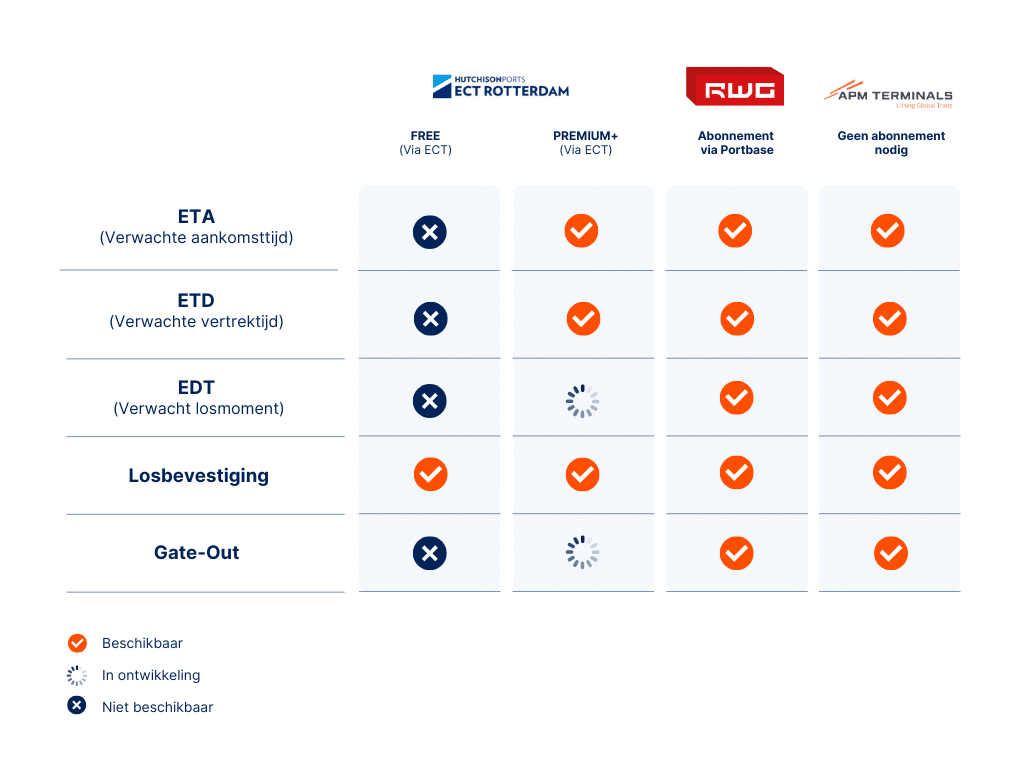
Choose ‘Premium Terminal Data’ and receive additional data elements from deep-sea container terminals ECT, RWG and APMT. This allows you to rely on more accurate ETA/ETD, ship and cargo information. In addition, it provides an estimated unloading time for each import container, based on the unloading sequence, taken directly from the terminal planning system.
Read all about this add-on and the associated terms and conditions on the Premium Terminal Data page. It is important to make an informed decision beforehand about whether or not to add this to your system, ensuring the data is immediately available once the integration is complete.
Service description
The Cargo Controller Import API uses webhooks (web callbacks or HTTP push API). When new status updates become available, the API automatically sends them to the endpoint specified by your organization. Portbase manages this webhook registration and ensures that updates are transmitted reliably and securely. You can find the specifications on this website.
Costs
If you are already using the Cargo Controller Import web screens, the service fees remain unchanged; you only pay the one-time setup fee for the API integration.
Please note: If you request an (additional) webhook at a later stage, we will charge an extra fee for it. If you request the webhook at the time the integration is set up, no additional charges will apply.
Frequently asked questions about API integrations
To create an API or system integration with Portbase, you need an IAMconnected account. Once you have an account, you can request a system integration via the application form and select the Cargo Controller Import service.
Yes, that is possible. You can find a detailed explanation of how to do this in the comprehensive article Implementing the Cargo Controller Import API on our support website.
Yes, these are available for both the technical integration and the functional process.
As you are likely aware, importing cargo always involves various scenarios. The CCI API provides numerous data points, allowing many of these scenarios to be identified or traced within our updates.
Implementing our updates as comprehensively as possible ensures your organisation derives maximum added value from this service.
We have detailed common scenarios in topic-specific use cases, which you can find in the articleImplementing the Cargo Controller Import API on our support website.
Yes, read the article Request an extra webhook for Cargo Controller Import in our support environment.
Portbase can rotate your RSA key. We do not do this by default, but you can request it during the implementation process or the testing period.
We apply a minimum rotation frequency of three months, and the transition period lasts a maximum of two weeks. You should factor this decision into your implementation plan, although it is also possible to add this at a later stage.
Portbase continuously develops its services; Cargo Controller Import undergoes frequent maintenance and receives new value-added features. We share our latest developments via email with (primary) users, through in-service messages for users in the web portal, and via our software suppliers.
More about Cargo Controller Import
-
Cargo Controller Import
Full visibility when tracking your cargo.